Industrial Springs: Types, Materials, and Selection for 2026
Industrial springs are precision-engineered mechanical components designed to store and release energy, provide calibrated return forces, or attenuate shock within high-demand machinery, agricultural equipment, and automotive assemblies. Unlike standard hardware, these components must maintain load performance through hundreds of thousands of cycles under specific temperature and stress parameters.
⚡ In a Rush? Key Takeaways
- Standard industrial gas springs provide up to 100,000 cycles under nominal conditions.
- Temperature drops of 10°C reduce nitrogen-charged spring force by roughly 3-4%.
- Stainless steel 316 is required for environments where salt spray or chemicals exceed pH 7.
- Always verify the force rating at the mid-stroke position for accurate application sizing.
What Are the Different Types of Industrial Springs?
Industrial springs include compression, extension, torsion, and gas-charged variants, each engineered for specific force delivery paths.
How do compression and extension springs function?
Compression springs resist inward force, while extension springs provide tension to pull components back to their original position.
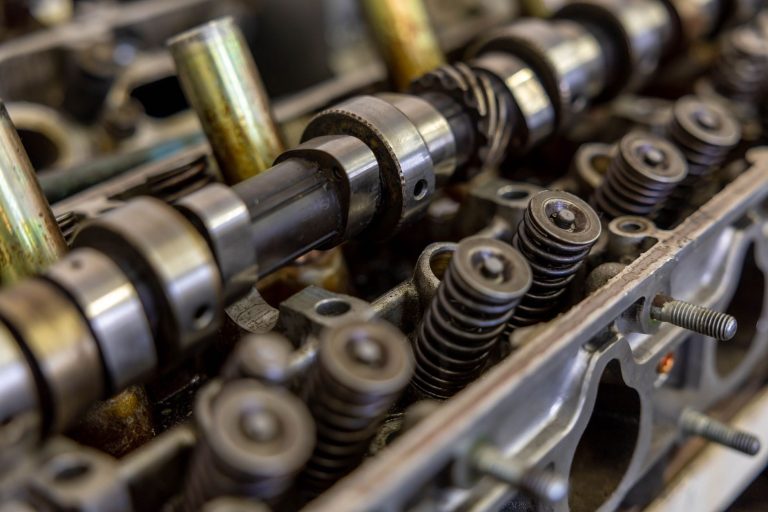
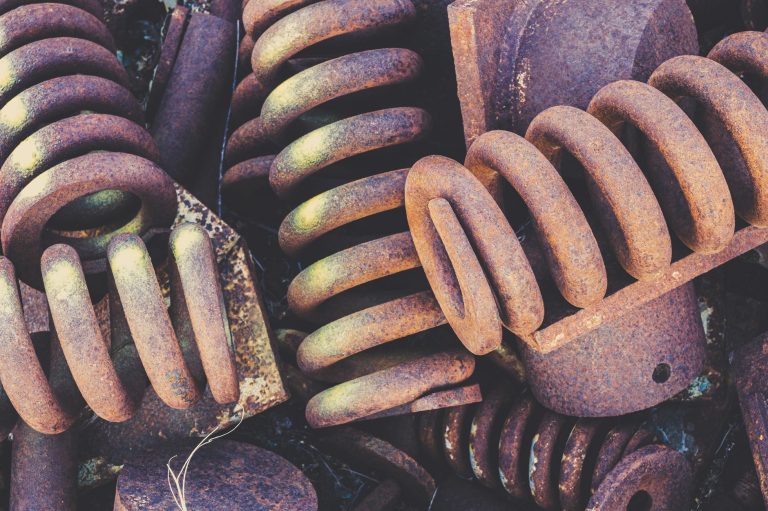
Compression springs are helical coils that resist axial compressive loads, storing energy as the coils are pushed together. In industrial gearboxes and valves, these serve to maintain consistent pressure between mating surfaces.
Extension springs use hooks or loops to provide a restorative force when pulled. In agricultural machinery, they are frequently used for latching mechanisms and tensioning systems that require high durability against vibration.
When should I specify a gas spring instead of a coil?
Gas springs offer a flat force curve and integrated damping, making them superior for lid lifting and heavy hatch actuation.
Gas springs use compressed nitrogen to provide a consistent force profile throughout the stroke length. This makes them ideal for equipment lids or heavy access panels where user ergonomics are a priority, as detailed in our gas spring force calculator guide.
- Flat force curve throughout the extension stroke
- Integrated hydraulic damping to prevent slamming
- Variable force options for custom lid weights
- Longer service life in high-cycle motion applications
How Do I Select the Correct Spring Material?
Selection is based on the operating environment, with carbon steel for standard use and 316 stainless for corrosive exposures.
Why does the operating environment dictate alloy choice?
Environmental moisture, chemical presence, and temperature extremes directly impact the fatigue life of high-tensile spring steel.
Standard music wire or chrome-silicon steel is sufficient for indoor, climate-controlled environments. These materials offer high elastic limits but lack resistance to oxidation if exposed to condensation or washdown cycles.
For food processing or pharmaceutical manufacturing, non-corrosive properties are critical. Specifying 316-grade stainless steel ensures structural integrity even when exposed to harsh sanitizing agents or moisture, preventing premature hydrogen embrittlement.
What temperature factors must be considered during specification?
Operating temperature shifts alter the modulus of elasticity, potentially causing a loss of spring force in extreme cold or heat.
Most nitrogen-charged gas springs are designed for a standard range of -30°C to +80°C. In extreme Arctic or furnace-adjacent applications, special seals and oil viscosity grades must be specified to maintain operational force.
| Condition | Recommended Material | Typical Application |
|---|---|---|
| Indoor/Dry | Music Wire | Internal Gearbox |
| Outdoor/Mild | Zinc-Plated Steel | Farm Latch |
| Corrosive | 316 Stainless | Marine/Chemical |
What Are the Most Common Causes of Spring Failure?
Failure typically results from over-stressing the elastic limit, cycle fatigue, or mechanical wear at the mounting end-fittings.
Why do springs lose force over time?
Force loss occurs through either permanent set after exceeding the yield strength or gradual gas leakage in pneumatic units.
For coil springs, a permanent set happens when the material is compressed beyond its design limit, preventing a full return to the free length. This is an engineering error during the initial load-deflection calculation.
For gas-charged springs, the primary failure mode is seal degradation. Once the internal seal loses its integrity, nitrogen pressure drops, leading to an inability to hold the rated load during extension.
Are end fittings a frequent failure point?
End fittings such as ball sockets and clevises often experience wear long before the spring body loses its primary force.
Mechanical wear at the pivot point can seize the spring, forcing it to absorb lateral loads it was not designed to handle. For more guidance on selecting components, refer to our gas strut end fittings guide.
How Do I Calculate Industrial Spring Force?
Force is determined by the load geometry and the mechanical advantage of the mounting points relative to the pivot axis.
How do mounting points change the required force?
Mounting the spring closer to the hinge increases the force required to actuate, while further out reduces the load demand.
The effective force is defined by the torque generated by the lid or load against the spring’s resistance. Use our force calculator to map out the force curves before purchasing.
Can I replace a mechanical spring with a gas spring?
Gas springs are not direct replacements for mechanical coil springs due to differences in force curves and damping traits.
A coil spring provides linear force increases, whereas a gas spring provides a constant force with a progressive end-of-stroke damping effect. Ensure your mechanism can accommodate these performance differences.
How are industrial springs tested and certified?
Testing verifies load-deflection characteristics, fatigue life, and environmental compliance before springs enter service.
Manufacturers typically perform static load tests using universal testing machines to confirm spring rate and free length tolerances per standards such as ISO 10243 (compression springs) or DIN 2095 (extension springs). Dynamic fatigue testing subjects springs to millions of cycles at specified stress levels to predict service life and detect early signs of set or cracking.
Environmental tests — salt spray (ASTM B117), humidity cycling, and temperature extremes — ensure that coatings or stainless grades maintain corrosion resistance. Certification documents often include a material test report (MTR) and a spring performance chart that engineers use for design validation.
| Standard | Test Type | What It Verifies |
|---|---|---|
| ISO 10243 | Static load/deflection | Spring rate and tolerance for compression springs |
| DIN 2095 | Static load/deflection | Extension spring force at given extensions |
| ASTM E466 | Fatigue (S‑N) testing | Cycle life under fluctuating loads |
| ASTM B117 | Salt spray corrosion | Resistance of coatings and stainless grades |
| ISO 9001 | Quality management | Consistent manufacturing and traceability |