Die Springs Explained: Force, Life (2026 Guide)
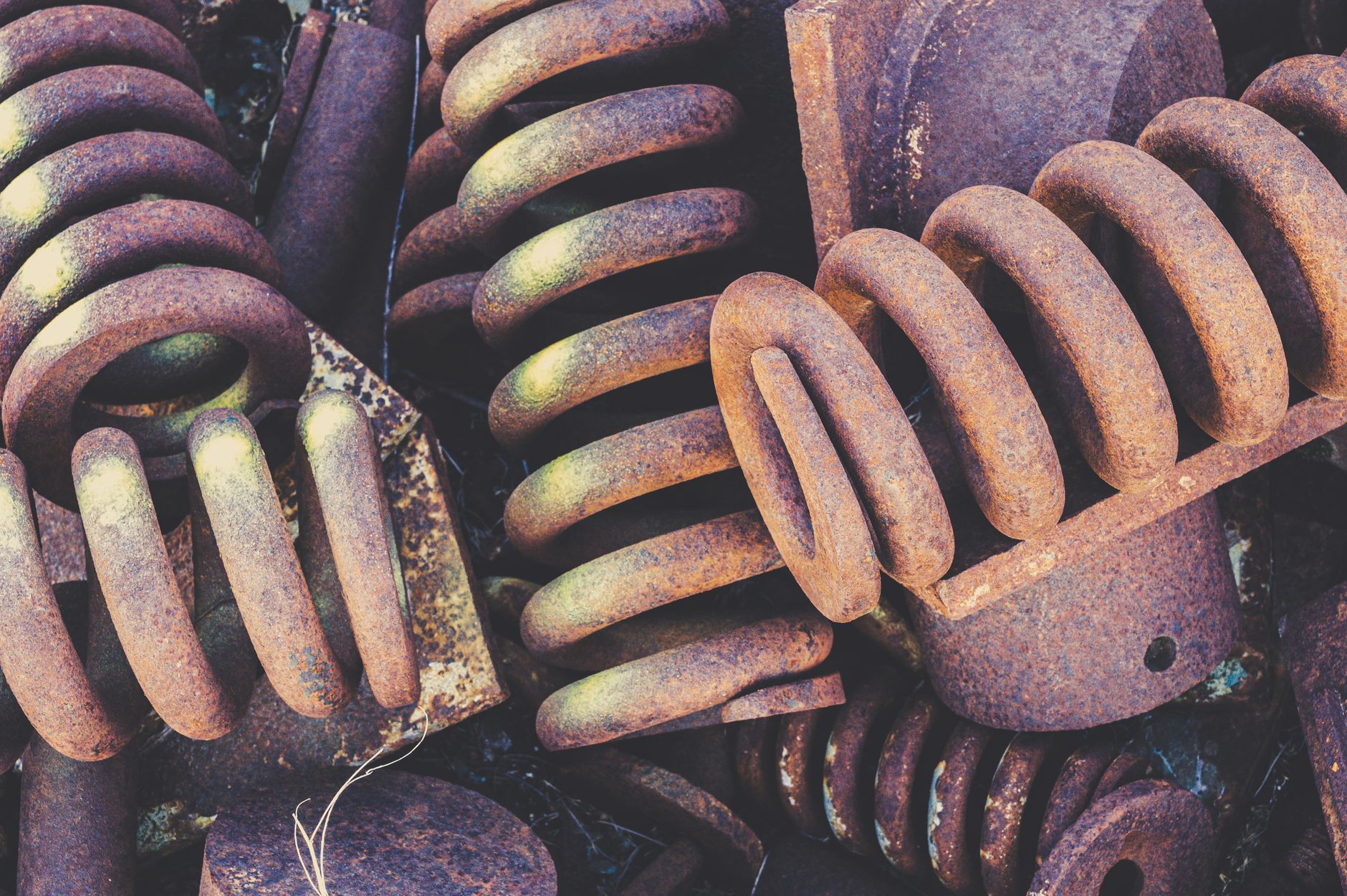
Die springs are high-force helical compression springs made from rectangular wire, designed for use in dies and molds where high load is required in limited space.
- Die springs generate 50-50,000 lbs of force depending on wire size and deflection.
- Chrome-silicon alloy provides 50,000+ cycle life at 30% deflection in stamping dies.
- Color coding indicates force: light (yellow), medium (blue), heavy (red), extra heavy (green), and ultra heavy (orange).
- Preload should be 10-15% of free length to prevent buckling and ensure consistent force.
- For stamping dies, select springs at 25% deflection for optimal life and force stability.
How do die springs work in die and mold applications?
Die springs store energy by compressing rectangular wire coils, delivering consistent force during press strokes to eject parts or hold components.
Die springs operate by compressing helical coils made from rectangular cross-section wire, which stores mechanical energy. When the press ram retracts, the spring expands, providing the workpiece or is the part from the die rectangular wire provides 30% more force than round wire in the same space. This allows high ejection forces in confined die spaces. Proper preload prevents buckling and ensures force consistency over thousands of cycles. Material choice affects performance: chrome-silicon handles higher temperatures and stresses than music wire.
- Rectangular wire provides up to 30% higher force density than round wire.
- Typical die spring materials: music wire (ASTM A228), chrome-silicon (ASTM A401), and chrome-vanadium.
- Operating temperature: music wire up to 121°C, chrome-silicon up to 232°C.
- End types: closed and ground, closed and not ground, or open and ground.
- Deflection limits: 25% for long life, 35% for maximum force, 50% for short-term use only.
How do I select the correct die spring for my die or mold?
Select die spring by required force at working deflection, then check color code, free length, and material for your application.
Begin by calculating the force needed at the point of maximum deflection in your die. Consult the manufacturer’s load-deflection chart for the spring series. Choose a spring where the force at your working deflection matches or slightly exceeds the requirement. Color coding indicates force range: yellow (light), blue (medium), red (heavy), green (extra heavy), orange (ultra heavy). Verify free length fits your die space and that end type matches your retainers. For high-cycle stamping, limit deflection to 25% of free length for maximum life.
| Color Code | Force Range (lbs) | Typical Use |
|---|---|---|
| Yellow | 5-50 | Light pressure, delicate parts |
| Blue | 50-250 | Medium pressure, general stamping |
| Red | 250-1000 | High pressure, forming operations |
| Green | 1000-2500 | Extra heavy, deep drawing |
| Orange | 2500-5000+ | Ultra heavy, high-force forming |
What is the expected life of a die spring and how do I maximize it?
Die springs last 50,000 to 1,000,000 cycles at 25% deflection; maximize life by limiting deflection to 25% and using chrome-silicon.
Die spring life depends on material, deflection percentage, and surface finish. Chrome-silicon springs achieve 50,000+ cycles at 25% deflection, while music wire lasts 25,000 cycles under same conditions. Exceeding 35% deflection drastically reduces life: at 50% deflection, life drops to 5,000 cycles. Surface imperfections from manufacturing or handling create stress risers that initiate cracks. Proper storage in a dry environment prevents corrosion-induced fatigue. Always inspect for cracks or permanent set before installation and replace springs in sets to maintain uniform force.
- Life at 25% deflection: chrome-silicon 50,000-1,000,000 cycles, music wire 25,000-500,000 cycles.
- Life at 35% deflection: chrome-silicon 10,000-50,000 cycles.
- Life at 50% deflection: chrome-silicon 5,000-25,000 cycles (short-term only).
- Storage: keep dry, below 50% humidity, away from direct sunlight.
- Installation: use proper retainers, avoid side loading, ensure vertical alignment.
How do I replace die springs in a stamping die?
Replace die springs in sets, compress with a spring compressor tool, and verify free length and force before reinstalling.
Never replace only one spring in a set; uneven force causes die damage and part defects. Use a spring compressor tool to safely compress springs for removal and installation. Measure free length of new springs; discard any outside ±1% of specification. Verify force at working deflection using a
Die spring stacking for increased force or stroke
Stacking die springs in series or parallel allows engineers to tailor force and deflection beyond a single spring’s rating.
When springs are stacked in series (end‑to‑end), the overall free length adds while the force remains the same as a single spring, enabling longer stroke without increasing load. In parallel (side‑by‑side), the free length stays unchanged but the forces add, giving higher load capacity in the same installation height. Manufacturers provide load‑deflection data for stacked configurations, and it is essential to use retainers or cages designed for the combined dimensions.
Typical applications include deep‑draw dies that need high force over a long travel, or progressive dies where stations require different force levels. Careful calculation of combined deflection limits is required: the total deflection should not exceed 25% of the combined free length for optimal life, and each individual spring must stay within its safe deflection range.