Gas Struts: A Complete Engineering Guide 2026
Gas struts, technically known as gas springs, are self-contained nitrogen-charged cylinders engineered to provide a controlled lifting, lowering, or holding force for hatches, lids, and industrial machinery. They use compressed nitrogen gas and a damping oil to achieve a force-balanced movement, allowing heavy components to be operated with minimal physical exertion.
⚡ In a Rush? Key Takeaways
- Standard industrial gas springs are rated for 50,000 to 100,000 cycles of operation.
- Force output drops approximately 1.5% for every 1°C decrease in ambient temperature.
- Overrating by 20% is recommended for outdoor industrial hatches exposed to UK winter temperatures.
- Always replace struts in pairs to ensure uniform force distribution and mechanical balance.
How Do Gas Struts Work in Industrial Applications?
Gas struts operate via a nitrogen-filled cylinder and a piston where gas pressure provides extension force and oil provides damping.
What Is the Internal Mechanism of a Gas Spring?
The system consists of a cylinder containing compressed nitrogen gas, a piston assembly, and a metered orifice for oil-based damping.
The core of the unit is a steel cylinder filled with high-pressure nitrogen. When the rod is pushed into the cylinder, the gas is further compressed, increasing the internal pressure and the resulting extension force.
As the rod extends, the piston moves through a small volume of hydraulic oil. This oil serves as a dampener, ensuring that the movement is smooth and that the component does not slam at the end of its travel.
How Does Temperature Affect Gas Spring Performance?
Temperature shifts alter internal gas pressure, causing a force fluctuation of roughly 1.5% for every 1 degree Celsius of change.
In cold environments, gas molecules lose kinetic energy, reducing the internal pressure and the effective Newton force rating. Conversely, extreme heat can over-pressurize the seals, leading to premature failure.
- Standard units operate reliably between -30°C and +80°C.
- Outdoor industrial installations often require seals rated for extreme cold.
- Storage temperature affects the longevity of the internal rubber seals.
How Do I Calculate the Correct Force for My Application?
Calculate force by multiplying lid weight by the center of gravity distance, divided by the number of struts and mounting distance.
What Geometric Factors Influence Force Requirements?
Force requirements are dictated by the pivot-to-center-of-gravity distance compared to the pivot-to-mounting-point lever arm length.
The force required is not just a function of weight, but of torque. A lid that is difficult to lift initially becomes easier as the center of gravity approaches the vertical axis of the hinge.
Engineers must prioritize the use of the Gas Spring Force Calculator to verify mounting geometry. Poorly positioned mounts can lead to mechanical binding or failure to hold the load open.
Why Is Mounting Position Critical for Performance?
Mounting geometry determines the mechanical advantage, affecting both the force output at the start and the travel at the end.
Changing the bracket position by even 15mm can alter the force curve significantly. If the strut reaches its travel limit before the lid is fully open, the structural integrity of the mount is compromised.
| Parameter | Effect of Error |
|---|---|
| Mounting Distance | Excessive binding or load instability |
| Stroke Length | Incomplete opening or premature stop |
| Angle of Attack | Reduced force efficiency at closing point |
Selecting Appropriate End Fittings for Gas Struts
The end fitting determines how the strut connects to the application and affects load alignment, ease of installation, and service life.
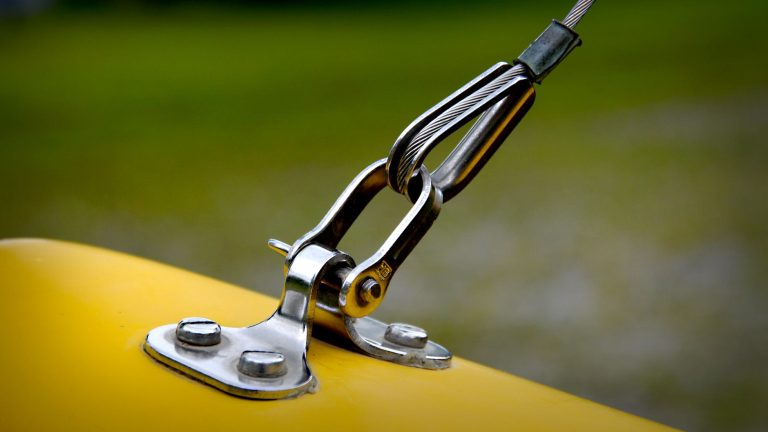
Common end fittings include eyelets, clevises, ball joints, and threaded studs. Eyelets provide a simple pivot point but can allow angular misalignment, while clevises offer a more constrained connection suitable for high‑load industrial hatches. Ball joints accommodate slight misalignment and are often used in automotive bonnets where movement is multi‑axial.
When choosing a fitting, consider the required range of motion, the material compatibility with the environment (e.g., stainless steel 316 for corrosive settings), and whether a locking feature is needed to prevent unintended disengagement. Matching the fitting’s bore diameter to the mounting hardware prevents play that could lead to premature wear or noise.
What Are the Common Signs of Gas Strut Failure?
Failure manifests as a loss of extension force, oil leakage around the seal, or visible corrosion on the chrome-plated piston rod.
How Do I Diagnose a Failing Gas Strut?
Monitor the time taken for a load to drop from open to closed position, as consistent drift indicates loss of nitrogen pressure.
A simple field test involves timing the descent of the hatch. If the lid reaches the horizontal position in under 3 seconds, the strut is dangerously undersized or depleted.
Consult our Gas Strut Stuck Open or Closed: Diagnosis Guide for detailed troubleshooting steps. Never attempt to manually compress a damaged unit.
Can I Repair or Re-Gas a Used Strut?
Industrial gas struts are sealed, non-serviceable units and cannot be recharged or repaired if they have lost internal pressure.
Once the seal fails or the nitrogen leaks, the component must be replaced entirely. Attempting to drill or pierce the cylinder is extremely dangerous due to the high internal pressures.
Frequently Asked Questions About Gas Struts
-
Are automotive and industrial struts interchangeable?
Automotive and industrial struts are not interchangeable due to different cycle life ratings, damping profiles, and mounting types.
-
Should I replace struts in pairs?
Always replace struts in pairs to ensure balanced force distribution and prevent mechanical twisting of the lid or hatch hinges.
-
What is the benefit of stainless steel 316?
Grade 316 stainless steel provides superior corrosion resistance in marine, pharmaceutical, and high-salinity industrial environments.
For bespoke industrial requirements or OEM procurement, please contact our Industrial and Agricultural team to discuss custom specifications.